
Few moments cause as much unnecessary panic for graduating students as sitting down to fill out a graduate scholarship or corporate trainee form and discovering the portal demands an exact percentage—while your official university transcript only displays a 3.62 CGPA or an 8.7 CGPA. Guess wrong, and an automated screening script might misread your academic standing or flag a discrepancy during document verification.
Making matters trickier, there is no single universal math formula enforced by every country. Different education boards, engineering councils, and national commissions publish distinct rules. Here is a clear, practical breakdown of how GPA, CGPA, and percentages actually relate, plus how to compute yours accurately using our CGPA to Percentage Calculator.
GPA vs. CGPA: What Is the Real Difference?
Although students often swap the two terms casually, they measure slightly different time spans:
- SGPA / Semester GPA: Reflects your weighted grade average across a single academic semester or term.
- CGPA (Cumulative Grade Point Average): Measures your overall weighted average across every semester completed so far in your entire degree program.
A frequent mistake happens when students add four semester GPAs together and divide by four. That only gives the right CGPA if every single semester carried the exact same credit hours! If Semester 1 carried 18 credit hours and Semester 2 carried 12 credit hours, Semester 1 carries 50% more weight. Inside our tool's Semester GPA Builder tab, entering both credit hours and semester GPA automatically handles weighted credit math properly.
How Major International Grading Scales Convert to Percentage
1. The 4.0 Scale (Pakistan HEC, USA & Canada)
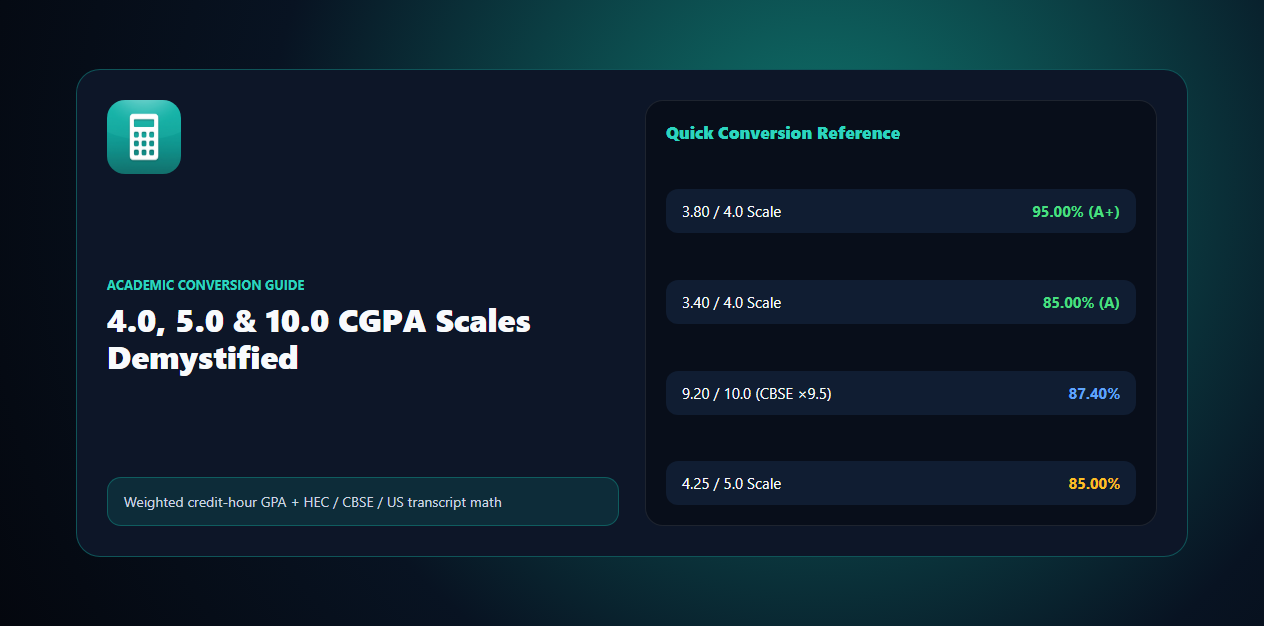
Universities across North America and Pakistan primarily grade on a 4.00 scale. When a quick direct percentage equivalence is needed for general resumes or internal applications, the standard linear proportion is (CGPA ÷ 4.0) × 100. Under this standard rule, a 3.60 CGPA equals 90.0%, and 3.00 equals 75.0%.
Important Local Caveat: Several Pakistani and international universities maintain their own letter-grade boundary charts (for instance, awarding a 4.0 GPA starting at 85% marks rather than 95%). Because of that, Pakistan's Higher Education Commission (HEC) advises students applying for federal jobs or foreign scholarships to inspect the back of their transcript first; if your university prints an official percentage formula or letter-conversion table there, follow your registrar's exact rule—or model it directly with our Custom Formula mode.
2. The 10.0 Scale (India CBSE, NITs & Technical Universities)
Indian secondary boards (CBSE) and numerous universities grade out of 10.0. Rather than multiplying by 10, CBSE established the well-known CGPA × 9.5 multiplier based on historical top-scorer averages—meaning a 9.0 CGPA converts to 85.5% rather than 90%.
Meanwhile, certain autonomous state universities apply (CGPA - 0.75) × 10 or direct CGPA × 10. Always check your institution's official marksheet footnote before choosing between our preset 10.0 (×9.5 CBSE), 10.0 Direct (×10), or Custom multiplier options.
3. The 5.0 Scale (West Africa, Parts of Europe & Engineering Institutes)
Institutions across Nigeria, parts of Scandinavia, and specialized technical academies run on a 5.00 scale, where 4.50+ generally earns First Class Honors. Standard proportional conversion follows (CGPA ÷ 5.0) × 100.
Understanding Academic Divisions & Honors Standings
Alongside raw percentages, HR departments and scholarship committees often categorize graduates by division:
- First Class with Distinction (typically 75%+ or 3.5+ / 4.0): Signals top-decile academic consistency across core coursework.
- First Division / Upper Second (typically 60% – 74% or 2.8+ / 4.0): Meets baseline eligibility for virtually all competitive graduate fellowships and engineering roles.
- Second Division (50% – 59%): Standard qualifying standing across most general employment screenings.
How to Estimate What Final-Year Grades You Need
Waiting until graduation day to inspect your cumulative standing leaves zero time to adjust. Midway through your degree, open the Semester GPA Builder inside our CGPA Calculator. Enter your completed semesters accurately with credit hours, then add hypothetical upcoming semesters with realistic target GPAs (e.g., 3.7 or 3.9). Seeing the exact mathematical impact of a single high-credit thesis project or summer course helps you focus study hours where they shift your final CGPA most.
Why Retaking a Low-Credit Elective Barely Moves Your Final CGPA
Students frequently feel shocked when earning an A in a 1-credit seminar barely nudges their overall CGPA by 0.02 points, while slipping from B+ to C in a 4-credit core engineering or medical lab pulls their cumulative score down dramatically. Understanding credit weighting early changes how you budget exam week energy:
- Multiply every course's credit weight by the grade points at stake. A 4-credit course carries four times the cumulative influence of a 1-credit lab!
- Early semesters (when total completed credits are still small, like 30 credits) swing your CGPA rapidly up or down. By your final semester (with 110+ completed credits behind you), moving an overall CGPA by even 0.10 requires near-perfect grades across a heavy final load.
European ECTS, UK Degree Classes & WES Evaluations
Applying to European universities (like Germany's TUM/RWTH using the inverted Bavarian 1.0–5.0 scale) or UK master's programs (First Class, 2:1 Upper Second, 2:2 Lower Second)? Keep in mind that formal credential agencies such as WES (World Education Services) evaluate individual course marks line by line rather than relying on simple percentage division. Still, keeping accurate percentage equivalents ready alongside your raw transcript helps you verify baseline scholarship eligibility—for instance, whether a 3.30 / 4.00 or 82.5% comfortably clears a "Minimum 75% / First Division" requirement before paying application fees.
Frequently Asked Questions
Should I round my converted percentage up (e.g., 79.8% to 80%) on job portals? Never round percentages upward on formal applications unless an electronic input rejects decimals. Enter two decimal places accurately (or follow your university's official rounded figure) so document auditors never accuse you of inflating grades.
Can I calculate CGPA across individual courses instead of whole semesters? Yes! Inside our Semester GPA Builder tab, each row accepts any credit value (1, 2, 3, 4, or 18) and GPA (0.00–4.00), so you can enter individual subjects within one term or entire completed semesters.
What if I repeated a failed course—does it count twice in CGPA? University policies differ: many South Asian and North American universities replace the old grade with the retake grade in cumulative GPA calculation while keeping both attempts listed on the transcript, whereas others average both attempts. Check your student handbook before projecting final honors targets.
Are transfer credits included inside CGPA? Generally, pass/fail transfer credits grant credit hours toward graduation without altering grade point averages, whereas graded transfer courses fold directly into weighted semester credit math.
Can I export or print my semester GPA plan for academic advising? Yes—simply calculate your target credit hours and upcoming grades inside the builder and take a clean screenshot or note the exact points needed before meeting your advisor.
Academic paperwork runs smoother when you verify every grade conversion calmly ahead of deadlines. Keep your original transcript formulas handy, double-check credit weights, and let clean calculation tools handle the numbers accurately.